Sunday, July 14, 2013

Armenian Coffee Klatch


I wrote this piece a couple of weeks ago…………………….
Living room in our Armenian apartment

It is quiet in the apartment now.  Several Armenian lady friends, neighbors who I’ve gotten to know in the past 2 years, came for coffee today.  They have now returned to their homes. I’ve had coffee in their kitchens and living rooms numerous times but never had them in my place all together.  It was fun, a bit awkward at times, but well worth the effort.  My Armenian/English dictionary was the other participant as we all used it to help with communication.  Even after 2 years, I need that dictionary in most group conversations------not really understanding what everyone is saying in the rapid normal pace of speech used by native Hayeren speakers.  Today was no exception.

Ruzan, my next door neighbor.  We communicated through our love of flowers, through smiles and hugs because neither of us knew the other one's language very well.
 
        Others were invited but had conflicts.   One significant conflict was experienced by my friend who has been trying to immigrate to the U. S. for over 4 years. She wants to go to the US because she is married to an Armenian American and wants to spend her life with him. Today, she had her VISA interview at the American Embassy with hopes of getting approval for immigration to the U. S.  Another neighbor had conflicts with the internet and communicating with her daughter in Russia so came later to have a cup of coffee with me after the others had left. She is my next-door neighbor and even with language barriers we’ve become friends, often discussing the flowers in each other’s garden or talking about the activities of her granddaughter who is avidly studying English

This was no huge event. I made several types of cookies and banana- nut bread which all of my Armenian friends have enjoyed in the past. We had coffee and fruit, and candy brought by one of them.  We chatted or rather, THEY chatted and I listened adding occasional comments.   It was not like a coffee klatch at home in America, but it was like being in Armenia, which is where I still live.  Here I am quieter and listen more whereas in the U.S. I am a talker, totally engaged in conversation.  That inability and lack of fluency in the Armenian language has been my greatest challenge and I felt it today. In spite of that, we were women of similar ages who were interested in each other on a surface level. We were neighbors and had become friends. This was our last such get-together before I leave and it was good.  The women were pleased because several of them had not been inside David and my apartment and I’m sure they were curious as to how we lived.   I was pleased because I was reciprocating for 2 years of hospitality offered me by them.  I was also pleased to again share some of what it is like to be an American, and I certainly learned more about the lives of these Armenian neighbors. 
Flowers in our neighborhood helped draw us together  and provide topics of conversation over coffee as we discuss gardening in America and in Armenia.

 
 It is a small world and when a relaxed, pleasant summer morning is spent sharing coffee with people from a different homeland, the realization of that fact becomes even more apparent.  Sargent Shriver, founder of the U. S. Peace Corps once said, “Peace requires the simple but powerful recognition that what we have in common as human beings is more important and crucial than what divides us.” To me, that is the essence of Peace Corps service and I felt it as I sipped my cup of coffee with these friends.

May they experience peace in their lives in Armenia after I resume life in the U. S. with that same blessing.        Judy

Thursday, July 11, 2013

Separation Anxiety and Nostalgia: Parting Emotions in Armenia


I’ve always loved the places where David and I lived.  Personally, separation anxiety always accompanies moving and settling in another place. Memphis and Germantown, TN. ,  Kure Beach and Wilmington, NC, and now Dilijan, Armenia are all special places to remember—places we’ve called home for varying lengths of time. As we prepare to leave Armenia, it is different. We will probably never return or see the Armenian people again. In the beginning, knowing that we’d only live here for 2 years created an urgency unlike the feelings of living in other places where time was unlimited. The need to make contacts, establish friendships and become a part of the life here was important, and all the while we knew our time was ticking away.  Now, the relationships formed with people we care about in Armenia must be kept alive through e-mail, Skype, snail mail and phone calls, not through visits one to another.
                Our friend and neighbor who made life joyful when she was visiting in our home. We shared a love of flowers and she is a great cook also. She speaks Armenian, Georgian, Russian and a bit of English.    The Armenian/English dictionary was our constant companion during conversations.


For me, sentimentality takes over as we have the ”last” meal with a family or attend the “last” wedding, khoravats, concert, or Peace Corps event. Writing the last grant (Dave) and teaching the last English class (Judy)  indicates that our close of service date is near.  Life in Armenia has not been easy but the challenges have been balanced by good times. Language issues, harsh weather, work difficulties, home sickness, travel limitations---are but bumps in the road of our overall experiences here.                                                                       

 
Now as we prepare to return to the U S., some of these previous irritations begin to lose their punch. “The weather wasn’t so bad, as long as we dressed warmly”, we now say. Or, “Riding the marschutni to Yerevan isn’t too uncomfortable and it’s much more economical”, we now think. Our language deficiencies have been the most daunting hurdles and merely confirm the fact that one must be reasonably fluent in a country’s language to be a productive Peace Corps volunteer. As we prepare to leave, I find myself thinking that the random people greeting me on the street seem friendlier and may be actually smiling. The mountains , now lush and green following early summer rains, are more inspiring. The wildflowers of countless varieties fill our eyes even more with their beautiful color and movement and cause us to question the worthiness of mowed lawns and uprooting of “weeds” in our former gardens. In Armenia , the flowers flourish in an environment of neglect where everything is gray, where trash litters the streets, and where abandoned buildings are allowed to collapse upon themselves without concern. The flowers are the bright spot, the color, the uplifting vision which helps to keep this world sane.

Now projects must be wrapped up, reports completed, and special good-byes shared. There is also the process of saying good-bye to our Peace Corps peers as we all begin to scatter around the world in pursuit of our next adventures. This experience occurred when we hastily left Niger, and to this day, we still hear from many of our fellow volunteers from Peace Corps Niger. We anticipate future reunions with some of these volunteers but probably not with our Armenian friends and colleagues.

Over 2 years of Peace Corps service in Armenia has provided opportunities to interact with people of a totally different culture though they possess the same human qualities, desires, concern and aspirations of our own culture. David and I see Peace Corps service in Armenia as vastly different from what we began in Niger. We believe our service in Niger would have been infinitely more productive due to the overwhelming need and engulfing poverty present in that African country.  We leave Armenia with feelings of accomplishment though much different from what we expected and on a much smaller scale. We can only hope that the 2 years of our lives spent here will result in improved lives of a few individuals whose paths we’ve crossed in Armenia. We know that neither we nor the Peace Corps can or want to change the entire world or even an entire population.  We would not trade our experiences in Armenia and Niger for anything. We return to the U. S. with our eyes opened wider by what we’ve experienced. May our altered perspective and clearer vision of how things really are in the world result in continued efforts on behalf of our fellow man.    Judy


                                            View of downtown Dilijan from Dave's office window

Wednesday, June 12, 2013

Bittersweet: A Beginning to the End of Life in Armenia


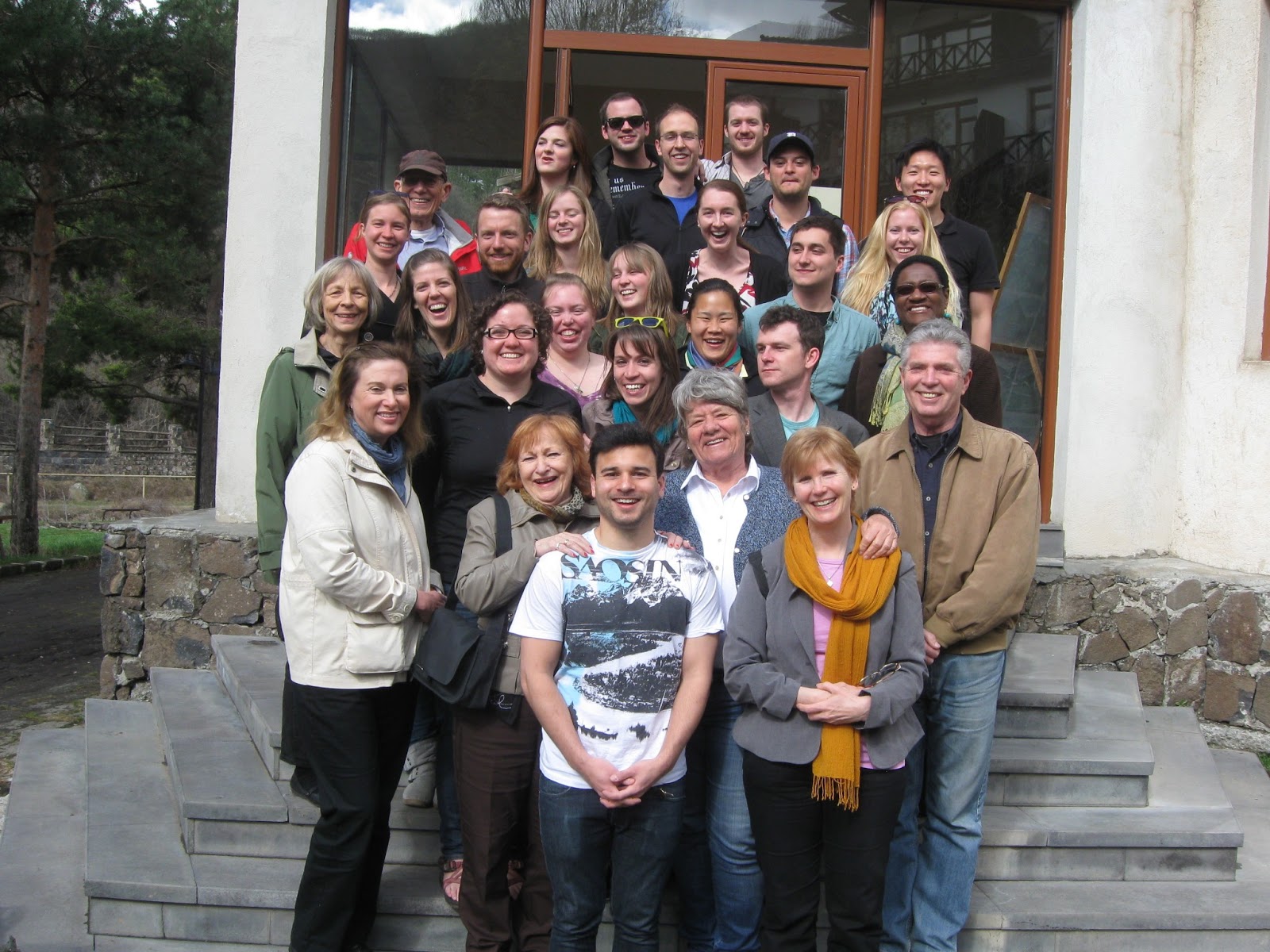
Our A-19 Peace Corps group, friends and colleagues we may never see again
                       
 One month from today, Dave and I will depart from Dilijan, go to Yerevan, and finish our lives in Armenia.  Now is the time when we are beginning to sort, pack, decide which belongings will stay here for new volunteers or Armenian friends and what is so worn, frayed and stretched that it must be discarded.    That means going through 2 years of what we brought with us and what we’ve accumulated from various places.  It is a task which is both daunting and at the same time refreshing.    It is a time to reconsider materialism and what one really needs. We did not need lots of “stuff” here. Our apartment was basically furnished so what we added to it were personal items and things to remind us of home such as photos, books and selected items we bought to take back home to remind us of our life in Armenia. We have bought very few clothing items and only very specific necessities  for the kitchen (for example, a  Teflon coated frying pan which has served us well and is the only one we have used for 2 years. ) And we bought good pillows, a task which took weeks to find just the right ones.  Pillows in Armenia are large, heavy and often filled with feathers of various types, not necessarily down as we know it.  Finding the right pillows to help us rest at night was a major accomplishment after arriving in Dilijan.  We have used the same set of sheets since going first to Africa then coming to Armenia.  We’ll keep remnants of those sheets to use in a quilt because they’ve seen us through almost 3 years of sleeping in foreign countries and are still usable.   Do we really need all of those sheet sets now awaiting us in storage in North Carolina.
      This time of sorting, re-evaluating and planning also highlights the changes which have occurred back home.   How will we adjust to those alterations in our former world?   Apparently, re-entry into a life in the US is more difficult that immersing oneself into life in a new, foreign country, at least that is what many former PC volunteers say.   
    As I look through various boxes and piles of “stuff” I am finding photo reminders and letters from family and friends.   I re-live the moment when I learned that my mother had quietly passed away, the week before David and I left for Niger, Africa.  At least we were able to attend her funeral and be a part of my family’s saying good-bye to her.    Then I ran across an envelope sent by my brother-in-law with items from my sister’s funeral in August, 2011, soon after we had moved to our site in Dilijan.  I did not attend that funeral so will never feel that I said a proper good-bye to my sister, Carolyn.   Then I found a copy of the medication list for our daughter and that brings back the year of treatment she endured to prevent a very specific type of breast cancer.  We were able to support her during that time thanks to an excellent telephone plan but it is not the same as being there to hold her hand or listen in person to what she was going through.  Our grandson became a teen-ager with the arrival of his 13th birthday in April of this year.  Will he still have time for his Tatik and Papik when we return?  And my father reached the ripe old age of 96 in December, 2012?  Although he continues to live alone and grow his annual tomato garden, how much longer will he be able to do that??  Dave’s sister had her 70th birthday, 2 nieces and 1 nephew were born into our family and our son became Director of the Agassi Preparatory Academy in Las Vegas. All of these seemingly routine events happened without us being there to celebrate or congratulate those involved. But did it make a difference?   Probably not to them, but in my mind I miss not having been there. Of course, the decision to join the Peace Corps also included the choice to miss such happenings and all Peace Corps volunteers have similar experiences.  There is no regret, just reflection on what we missed.

We attended this couple's wedding in Armenia and celebrated their new life together . They are our friends now and in the future.


           To balance these events we heard about in absentia, we’ve been closely involved in the lives of our new Armenian family, friends and colleagues. We recently attended the wedding of a dear young couple who befriended us early in our service and will continue to be long- distant friends for years to come. (Photo above).   One of our Peace Corps staff members will soon have a new baby daughter. We are supportive of those parents who must send their sons for mandatory military service, not knowing the outcome of such involvement. And we celebrate the successes of our Armenian friends who finish high school or university, become involved in gainful employment or even in meaningful volunteer activities.
         Life goes on whether in Armenia or America, and we have been a part of it. We have not put our lives on hold and we’ll continue to seek new experiences and adventures in the world while also keeping a foot in the door at home..  As my elderly Aunt Mary Nola, advises,“ You all stop, look, listen; remember each day’s work. Where am I? What do I do next? Enjoy each day you have. When you get old and in your sway-back-and- forth chair you can re-live each moment again and be happy.”  Aunt Mary Nola also says in a recent letter, “So good to hear the good news of travel. Keep it up till you drop, then like a “bird” find a nest, near friends and family. Everyone needs a nest to return to at the end of a fruitful life.” 
Dave with Aunt Mary Nola


          Thanks, Aunt Mary Nola, for those words of guidance and wisdom.      Judy                             

Wednesday, May 15, 2013

I THINK I'M BECOMING ARMENIAN,,,,,,,,,,,,,,in Armenia!


The following are now common in my daily life after 2 years living in the Armenian culture:
 Wearing slippers: both inside and outside is a habit. I’ve almost worn my purple slippers with the silver bows to school, without thinking.
My favorite comfy Armenian slippers, given to me by my friend and counterpart, Christina


Saving a teabag and using several times is  fine unless you prefer very dark tea!


Re-using tea bags is a common Armenian practice and I do it all the time now.
                                                       
Discovering that a cup of Armenian coffee with sweets can revive me and give me energy to skip lunch on a school day (not a healthy habit but one practiced routinely by my Armenian teacher friends)


Always carrying candy in my purse. It comes in handy on a crowded marschutni (bus) when a child is fussy or in class when a student earns a small quick reward. (I have candy canes left from Christmas and Armenians are fascinated by them!)

Taking candy, fruit or other small gifts when visiting someone’s home (homemade American  cookies or brownies win rave reviews!)

Wearing more black, gray or brown clothes equals immersion into the clothes culture of my Armenian friends and colleagues. (I still like to add some bright colors to this dismal fashion picture.)
Note that most of theses teachers are in BLACK attire!
                                                                 
      Carrying extra items in a plastic shopping bag and clutching one’s purse on her lap is the picture of an Armenian woman on the avtobus or marschutni. (I do this without thinking now.)

      Offering coffee to anyone who enters your home for any reason and accepting the fact they they’ll probably say “yes”.

      Paying attention to the cleanliness of footwear even after walking on wet and muddy or dry and dusty streets. (I try but do not measure up on this one!)

     Being prepared to answer the question, “Do you like Armenia? “ or “Do you like Dilijan?”  I can say “lav na!” (It is good, in Armenian.) Do you greet a visitor to the US immediately with the question, “Do you like the U. S.?   This is a routine question posed at most initial encounters with a new person here.

     Accepting that Armenians will urge me to “eat, eat” at every meal, coffee time or any occasion with food involved. (I do the same to Armenians when I take food or baked goods to them.)

    Always sitting in the back seat of a taxi and reminding Dave to sit in the front. (not bad since the front seat passenger is usually expected  to pay the fare!)

    Ignoring the plight of poor hungry cats and dogs all over Armenia. (It breaks my heart to see them, but I know we can’t help all of these animals, so Dave and I take scraps occasionally to our neighborhood dump where they congregate.

                                                          
Cats waiting for dinner at the  neighborhood  dump site


      Eating ice cream only in the warm months because that is when it is available in our town. (I cheat whenever possible if we are in the capital city, Yerevan, where ice cream is widely available year-round.)
Homemade brownie with a block of Armenian vanilla ice cream is to die for!

        Bathing every 4-5 days instead of daily. ( I actually can do this without worry in the winter, but summer is a different story.)

      Wearing the same outfit to school for several days in a row as my colleagues do. (It is certainly easier to wear the same clothes over a period of time and everyone does it here.)

      Successfully carrying raw eggs loose in a plastic bag after purchase in the neighborhood market. (Eggs also need not be refrigerated if used within a few days.)
                                                              
Thin plastic bag does just fine to transport eggs........unless you drop it!!!!


     Staring straight ahead without eye contact while riding on the local marschutni. (I have yet to figure out WHERE to focus one’s gaze during these rides but I try not to look directly at any one person.
This is the local avtobus.  Don't make eye contact with other riders when sitting on the bus.  It is culturally unacceptable.


       Not automatically smiling and speaking to everyone on the street or on the avtobus. (I still make an effort to smile and speak to most women and children but NOT to the men because it is culturally unacceptable.)

       Carrying an umbrella at all times.  The weather in our town is very unpredictable and often a sunny morning can turn into a rainy, cold walk home after school.

Umbrellas  protect Armenian women from sun, rain, snow and any precipitation.  I take one almost every day.

       Sometimes I think Dave and my last name is SmithYAN (our host family during Peace Corps training called us Dave and Judy Smithyan because the –yan ending on a surname is typically Armenian.) We do not deserve that designation but appreciate the thought.

       These  reported scenarios help me to feel more immersed into the Armenian culture which we’ll be leaving in less than 2 months.    Wonder how long it will take to break these acquired habits and not be so Armenian back in the states????

Judy


Sunday, March 31, 2013

Is Youth Wasted on the Young?


Youth is wasted on the young! As one of the topics for the Peace Corps’ International WRITE ON! Contest, these words made me stop and think.  And when I did think about it, I decided the familiar saying is not true----at least not all of the time.   Since David and I are the oldest volunteers in our specific Peace Corps A-19 group serving in Armenia, we frequently listen to ideas and opinions of our younger peers.  Many times we agree with them on subjects of common interest.  Some we totally disagree with due to our different perspectives and life experiences.  And some we aren’t sure about.   But I personally do not think youth is wasted on the young. 

     Let’s talk about how to spend one’s money wisely and, specifically, where to stay when spending a night or 2 in Armenia’s capital city of Yerevan.    Most of the younger volunteers stay at hostels in the city. There for a nominal fee, most hostels offer a room with multiple beds or bunks, hot showers, decent bathrooms either community or shared, and breakfast. During our time with the Peace Corps in Africa, we stayed in a hostel when in the capital city of Niamey.   It was quite large, usually crowded and many of the beds or cots were located outdoors due to the heat and the absence of air conditioning in that country.  This  Peace Corps sponsored hostel was usually dirty, with leaking water faucets and toilets, dirty dishes always present in the kitchen area and personal belongings strewn about the place. It was reminiscent of living with one’s own teenagers when rules were not adhered to. We felt out of place and frankly, disgusted with some of what we experienced.
    Once we came to Armenia where there were more choices for lodging, we said we’d not stay in a hostel, that we were too old, had “been there done that,” etc.   But our younger friends kept saying how nice one of the hostels was and that other older volunteers did stay there. Our peers understood and really didn’t care where we stayed, but as we spent more of our own savings and continued to stay in hotel rooms which we loved but knew were too expensive, we thought, “maybe we should give the hostel a try”.   Maybe we should listen to our young friends and fellow volunteers. 


      Well, this past weekend we did stay at the Envoy Hostel in Yerevan, Armenia. What a pleasant surprise did we have!  We opted for one of their limited numbers of private bedrooms with a shared bath as our first test of the establishment.   It was fine.  For a reasonable rate we had a comfortable, clean, conveniently located place to stay and no problems.  Staff members treated everyone with professionalism and kindness.  They were willing to help with anything we needed.  Breakfast was simple but good and certainly an acceptable deal for the cost.  We were free to add other items we wanted without a problem and they even served whole milk for cereal, oatmeal, coffee, etc. What a treat after rarely having milk in Armenia!  The best part of a stay at the Envoy is meeting the people who also stay there, both from Peace Corps Armenia and from other parts of the world.  One young man was playing his guitar in his room before others arrived to join him. It added to the almost hippie atmosphere of the place to hear the strains of his simple chords and voice throughout the building.  The recreation room which doubled as the eating area, was large and well equipped with flat screen t. v., computers, plenty of seating and a number of board games should anyone want to play.   The kitchen was fine and apparently may be used by guests under certain circumstances.  Everyone tends to their own business at the Envoy yet the feeling is warm and welcoming on the part of visitors and staff alike.          
Creative mobil decoration hanging in The Envoy
     
     Yes, we should listen to the young more often. Young people are willing to check things out, take chances we might not take (sometimes that is good, sometimes, not), and they are honest when giving their opinions. For David and me, listening to our younger peers is often a reality check on how things really are in their world and it helps us to gain a more up-to-date perspective of our own world. Although we had found a new hotel which gave us an appreciable discount when we stayed in Yerevan, and we feel as if their staff is part of our family, I think we’ve found another “home away from home” at the Envoy Hostel in Yerevan.  There is also a sister Envoy hostel in Tbilisi, Georgia equally as well recommended by the young. 

      Youth is not wasted on the young. It is experienced by the young.  It is enjoyed by the young and it should be respected by their elders. Why……..we were once young, too.
  
       Check out these photos from our recent stay at the Envoy Hostel in Yerevan, Armenia.They all make me smile!  
                                                                
Vehicle parked outside The Envoy and driven by
young couple staying in the hostel as they travel around the area.

I think this artsy mobil signifies "home sweet home" with all the small paper houses.  That's what The Envoy becomes to many of its regular visitors.

The Envoy has this image on its outside wall. Yerevan was designated as the World Book Capital in 2012. 


Look who's riding on the back of the camping vehicle!


Young people work at The Envoy, all ages stay at The Envoy and young people told David and me about it.  Youth is not wasted on the young, at least not in this case.  

Judy


Thursday, March 14, 2013

Walk the Walk in Armenia


  I leave my college for the walk home. Today I am alone as other teachers must stay behind to complete work on records which I do not have responsibility for.  I look at the view from the sidewalk as I ascend the steep hill leading to the town's main road and later to David and my apartment.  
Snow on mountains in the distance, lingering , waiting for one more  snowfall .

  The uncharacteristically gentle March wind is at my back as I continue the walk home from a day of classes. It blows my hair forward; as wisps of hair tickle my eyes, the view ahead is momentarily
 hindered. The sun adds warmth to the spring chilliness and my mind wanders, as it often does, on these 25 minute journeys home through the neighborhoods with which I am now quite familiar. I hear the wind’s sound as it rushes through the pine trees around me. 
Large pine typical of those lining our streets and which were covered with snow last week


Their swaying movement appears to be synchronized like an orchestra whose violinists all lean in one direction as they perform music in concert with each other. These musical evergreen trees are now forest green and free of the snow just recently adorning their branches.  It is spring in Dilijan, or at least today it feels like it. ( I’m told we still might have another snow though.) Children along the way greet me with their smiles and mechanical “hellos”. They make the trip more than worthwhile after spending the first hours of the day with unmotivated and sometimes surly teenagers at my college.
As I walk it comes to mind that in 4 months Dave and my Peace Corps service will be over. Thinking about that short time, out of a total 27 months, makes the neighborhood and all that has become familiar more impressionable.  Although there are negatives, I don’t want to forget some of what is “just Armenia”, as we non-Armenians say when an event or a happening is beyond our understanding or comprehension aside from being culturally appropriate.   As I walk, a short legged little reddish-brown dog follows me. We see it every day when walking to work. I see older men standing in groups on the sidewalk, smoking and chatting, nothing to do and nowhere to go.  Across the street are younger men, also smoking and chatting as if following the pattern of their elders on the opposite side. This is one thing which is bothersome to an outsider---the lack of involvement of our town’s ordinary men who seem truly to have nothing to do.  Yes, unemployment is extremely high and selected men do work in local stores, drive avtobuses and taxis,  and do construction work at various sites, etc., but there are still countless men who prominently “hang out” day in and day out. We see them every day.
       As I continue my walk, other regular sights and activities come into focus.  I see the numerous small neighborhood stores vying for business, people waiting at the avtobus stops to go to the center of town, children arm-in-arm, leaving the local school to go home, and a dog and a homeless man seeking their lunch from the same overflowing garbage can
Small store seen every day on the way to my school and David's work


. I see the local elderly woman who walks every day, mumbling to herself, carrying cardboard boxes she collects along the way. She is followed at a respectable distance behind, by her daughter, who we surmise must accompany this woman to assure her mother’s safe return home.  Allegedly both of these women were local teachers until the elder one became mentally challenged and now requires supervision by the younger. I feel empathy for the daughter and sadness for the mother. And I see the myriad of clothes lines high off the ground and loaded with clothes drying in the sweet breeze of a spring day—so much better than a week ago when the same lines were laden with frozen garments stiffly swaying in the frigid late winter wind. I wondered at the time if they ever actually got dry????
Avtobus stop where people wait for a ride to the center of Dilijan
           Photos to follow will show a few other typical neighborhood sights which we see daily and take for granted.  Soon those sights will only be memories stirred by photographs made in Armenia and thoughts aroused by sounds, smells, and experiences re-lived with others.    Pictures tell a story.  I hope you enjoy them.

Sign atop an abandoned dairy business near our street

This sign is near our apartment.  We've seen the hotel but not CASANOVA.
Litter is everywhere in Dilijan. It is an eyesore which does not seem to bother local people  but is an obvious detraction for tourists and those of us concerned about the environment.
These children asked that their photo be taken as I walked home today. Of course, I was glad to snap their picture and will get prints made for them.   Children love to see themselves in pictures.
Children I meet along the way make this walk more pleasurable and more memorable as I contemplate leaving Armenia in the near future.  We all walk the walk  together, as we live in Dilijan. 


 see 

Friday, March 1, 2013

DOGS on my MIND


                 I should be asleep, resting for the next day, but I can’t sleep.  There is a dog howling  somewhere on the ground ,14 floors below our  hotel window. It is a mournful sound and repeated every few seconds as if controlled by a timer. I picture the dog’s head  thrown  back and its mouth forming a string of o’s …….just as depicted in a favorite Far Side cartoon I saved for years. But in that cartoon, someone was there to respond.  This dog howling on the streets of Yerevan is most likely a stray with no home, no owner hence, no responder.  The howling eventually ceases. Is that because someone threw the dog a bone or because it just gave up and quit????    Even with the silence of night returning, I cannot sleep.  Now I’m thinking of other such dogs we’ve seen in Armenia and it keeps me awake.
                          
           I can see in my mind’s eye, the pathetic mother dog we encountered on the street yesterday.                                          

Though not frail or emaciated looking , she had probably  whelped her puppies recently.  Her breasts were swollen and red and she was scrounging for food along the gutters of the street. Where were her newborn pups? I’m certain they were not waiting for her in a warm basket or in a box with a blanket, prepared especially for their coming. Most likely they were nearby in one of the old concrete buildings,  huddling underneath debris of some sort , where the mother dog was trying to shelter them from the cold February winds of Armenia.  How could she or any other mother dog feed herself and nurture her pups as a stray on the street?
                    I then visualized  the dogs in our town that are routinely tied up to trees  or stakes, trapped at the end of meter-length chains where they spend their days “protecting” the dismal property of their owners by barking ferociously at each passer-by. Being a watch dog is a job.  One dog in particular emerges from his cold, metal 50- gallon- oil- drum- home each morning as we walk to work.  He appears to be strong and ferocious with a daunting bark and demeanor,  but what can he do with only a bit over 3 feet of freedom.   We occasionally witness his owner pouring some kind of gruel into his bowl, so at least he is fed. In the summer it is the same routine, but it is hot. That is no life for an animal. Another dog I see at the bus shelter near my college is a large, mixed-breed animal with a heavy fur coat. What attracts my attention is the way this dog sits majestically guarding its owner’s backyard, but rarely does it bark.  It sits erectly and quietly, all the while, appearing to observe those of us waiting for the local avtobus.  Though students are laughing, running around and talking, the dog does not seem to feel threatened and does not test the length of his restraining chain to bark and snarl at the activity nearby.
                    As alternative and more pleasant thoughts, I picture the cute little pug puppy I saw today in a nearby park. It had a collar and leash and was being hugged by its young female owner. Then there is the volunteer who is making arrangements to take her adopted dog from Armenia back to the U. S. Finally, I think of the beautiful blond cocker spaniel we see in the Green Bean coffee shop in Yerevan. This dog's owner rescued it when the dog's former owner could not continue to care for the animal.  It now visits the owner's restaurant is is obviously loved and well cared for in Yerevan, Armenia.       These dogs are exceptions and they are the lucky ones.   They have unknowingly encountered kind humans who care for them and treat them as something having value as living creatures in our world.
                  Unfortunately, there are so many more dogs in Armenia and around the world that merely survive, reproduce and continue the cycle of keeping their kind alive.
Stray dogs resting in intersection of streets in Yerevan,Armenia
                                                                         
   Then there are the "dump dogs"---born near the garbage dumps, fed by the garbage, and thrown there when they die.  There are the abandoned dogs who lose owners for various reasons just as in the U. S. They suffer from not being accustomed to life on the street. They are seen walking up to strangers, wagging their tails and appearing to be friendly as they beg for food.  Then the stranger kicks them or yells for them to “go away”.   Only once have I seen anyone respond positively to such an animal. It was at the bus stop and a child gave the dog his hunk of bread.  The adult accompanying the young child encouraged this action. It was literally the first act of kindness towards a stray animal that I’ve witnessed in Armenia, and it may be the only one.   
               A stray dog that received a hand-out from a kind child but  looks like it has already been abused.  Ears are totally gone, the probable result of unnecessary cropping done inhumanely. 

           As I lie awake thinking of all of this, my eyes begin to feel heavy and I know sleep will come in the wee hours of this morning. I also know I must write about these thoughts. As in other writings, it is more a compulsion to clear my head of such ramblings than to produce a solution to this troubling issue in my current world. I am not up to problem solving in this culture of poverty and neglect where people, too, have their stresses every day.

                 The next day, David and I again see the previously mentioned  mother dog looking for food near our hotel.  I buy her a small packet of dog food, return to where she is walking around and open the food for her.  Of course, she laps it up quickly and tries to eat the packaging before another stray dog comes to investigate. My impulsive act does not solve this dog’s problem, but it makes me feel better for the moment. I was pleased that the dog did not run away in fear or growl and bark at me. Maybe this is a sign that she is being fed by others who take pity on her plight.  Maybe there are more caring people than I’m aware of.  These thoughts provide comfort for the moment. Maybe I just have to live with that.

Mother dog scoffing up small package of dog food
                                                               

  1. Note:The dog to the left is a beautiful cocker spaniel owned and cared for by the owner of the GREEN BEAN coffee shop in Yerevan.  This shop is one of the only smoke-free cafes, coffee shops or restaurants in Yerevan. It emphasizes natural ingredients in its foods, recycling and an over-all green focus. The owner is interested in helping stray dogs and actually rescued this blond cocker spaniel when its former owner was no longer able to keep it. The dog comes to work with its owner on some days and is treated royally.  There are some kind people in Armenia and, hopefully, their numbers will grow so that animals are better treated. With that thought in mind, I finally drift off to sleep...............................Judy