Sunday, October 30, 2011

ET but not THE Extra Terrestial

                                                      
Some thoughts on a cloudy day in Armenia………………………

Mike , Peace Corps volunteer and musician extraordinaire
                                                                       
A volunteer in our group has decided to ET or early terminate as we Peace Corps people call it. There are many valid reasons for a volunteer to ET such as health issues, family concerns back home, cultural challenges in the volunteer’s country, work related problems, financial issues, weather related dislikes, personal disagreements with Peace Corps policy,  etc.     Not being a close personal friend nor willing to divulge this volunteer’s reasons for his ET even if known, we are just sad that he made the decision.  Sad, yes, but respectful of that decision as one which he told us, was one of the most difficult decisions he’d ever made.   After experiencing all of the challenges associated with application, evaluation and acceptance into a training class with the Peace Corps, packing 2 bags for his 2- year anticipated service, then traveling ½ the way around the world, Mike reached Yerevan, Armenia. He then studied a new language and new alphabet and began to immerse into a new culture.  Mike passed the required language proficiency test, and raised his right hand to swear in as an official Peace Corps volunteer in Armenia. After that came the settling in process in a new town and work place and finding a permanent home for himself for his 2 –year assignment in Armenia.  All the volunteers in our group followed basically this same path, BUT……….Mike will ET and leave Armenia this coming week.   
To make this departure even more dramatic is the fact that Mike is a talented musician and recently retired university professor of music, primarily piano and keyboard instruments of all kinds. In addition, he is a skilled arranger and composer of music, captivating performer, unbelievably patient director of choral and instrumental groups of all levels, and a generally great guy.  Mike utilized his comprehensive abilities in the field of music to arrange music and train performers for our group’s swear-in ceremony in mid –August.  Because of his abilities, a group of 25-30 volunteers, many of whom were non-singers to begin with, performed a medley of American songs followed by a traditional Armenian musical selection sung in Hayeren, the Armenian language.   He also coached and accompanied a young volunteer, Joseph Andriano,  in a breathtakingly  beautiful tenor  solo performance of the Armenian folksong recorded by  Komitas,  Chinar Es. This musical addition to the Swear-in ceremony held in the Komitas Chamber Music Hall, was a special tribute during the year of the Peace Corps 50th Anniversary.  All bets were on that Mike would share his talents with the next group of volunteers as they participated in preparation for their swear-in event in 2012.
Joseph Andriano, Stephanie with cello, and Mike on piano
 at Swear-in Ceremony for Peace Corps Armenia Volunteers , August 16, 2011
                                                                               
                                                                      
Now that Mike is leaving us, that will not happen, however, the memory of his work with our group in 2011 is recorded for Peace Corps history.   Congratulations or shnorhavorank!  to Mike, for all that he has accomplished while in Armenia. He should be immensely proud of how he has touched the Peace Corps volunteers and staff, the Armenian people, and especially the children, with his music.  When there was a piano present, Mike played it without reserve. When the piano needed tuning, he arranged to have it done. When music was desired, Mike was there. We know the decision to ET was mind-boggling and difficult, yet a person who chooses that route has our utmost respect for recognizing that the decision had to be made, for whatever reasons. 
 Yes, we are sad that Mike is leaving but glad that he can move ahead with his amazing life. While his music will truly be missed in Armenia, there’s bound to be music wherever Mike goes in the world. We’ll all be waiting and listening to hear it.          Good luck or Hajoghutyun!  We’ll miss you, Mike.
Judy and David 

Saturday, October 8, 2011

SNOW! on October 3-----that's ARMENIA!

       Dzyun , or snow----in Angleren/English----appeared today,  on the mountains which we see from our porch.   It was cloudy and gray when Dave and I left for our work this morning. I left later than he, since Monday is not a teaching day for me, but one in which I can do planning and lesson preparation without a real schedule. The snow was not visible when I left home and I was concerned that it would rain, andzrev, and never thought of snow!!  True enough,  the snow was in the highest mountains, not where we actually felt it.  However, never in the past 68 years has there been snow present in my town only 5 days after my birthday!!!     Is this a hint of what’s to come???    One of the daunting aspects of living in Armenia is the weather, particularly where Dave and I live.  Because of the mountains, beautiful as they are on a clear, sunny day, they influence the weather in a way which produces more moisture, days- on- end of dreariness, and low hanging clouds which engulf the mountain tops and hover over the ground below.  It is always a blessing to leave school and find the sun shining when the morning so often brings these cloudy conditions.
                                                                
       So, snow has arrived in Armenia which means the snow boots I bought before leaving the U.S. will soon be unpacked.  It is cold enough that I’d really like to wear them now but prefer not to show all of my wimpy characteristics at once. Plus, snow is not actually on the ground yet in Dilijan.  The staff members at my school already check to see how many layers of clothing I have on when I arrive in the morning, after I have walked about 25 minutes from home.  Most of them tend to dress very nicely and would rather be cold than unstylish. They laugh at me!  But,  I can hardly believe the attire of some of the teachers who are dressed to easily attend a semi-formal event or certainly a dressy art show opening or symphonic concert in the U.S.  This is typical of Armenian women in general, but since I work with teachers,  that is where my impressions are focused.  There are the older faculty members who wear dressy suits, often adorned with sparkle and shine.  Without question, black and white in various combinations, describe the color range.   Then there are the younger teachers who wear beautiful clothes, again mostly in black and white. Even though they may only have a few basic pieces, these women are masters (or mistresses) of coordination as they combine a few skirts with a handful of tops and jewelry. Always appearing well dressed, they would be over- dressed in the scope of American teacher attire.   I, on the other hand, continue to be a conservative dresser both due to age, my own style and what I brought to Armenia, plus I DO NOT WANT TO BE COLD!  Knowing that fact, a young teacher brought me a wonderful pair of softly lined tights today and asked if I’d like to have them. She said the color was wrong for her.  I don’t care as long as they are warm, which they will be, and I’ll find something to wear them under as another layer to ward off the damp chilliness of this season.  I intend to maintain my own identity yet do try to respect the culture in this new country, therefore, as new items are purchased over the next 2 years, I’ll consider some of more modest  choices in Armenian women’s attire.

                                                  Tourism students and their birthday gifts                            

                                                                               So, winter is coming. I’m not sure I’m ready although Dave is.  In order not to think about it, I choose to reflect on my first birthday in Armenia. That is a heart-warming memory for sure.  The students in my classes surprised me with handmade Armenian gifts of a lovely ceramic pomegranate wine vessel which may double as a vase, along with an accompanying salt dish with its own tiny spoon.  Dave and I ate dinner out with our host family who had 2 members also with September birthdays. We shared that evening with our site mate, Kellianne, an amazing young volunteer also serving as an English teacher in Dilijan. Numerous Facebook greetings, e-mails from friends in the U.S. and well- wishes from my school staff, counterpart, and host family made the day quite special.  Though unexpected, a late September birthday and an early October snowfall paired quite well.  I hope to celebrate the birthday next year, but maybe the snow will be delayed until a more appropriate time on MY calendar! 
                                               Dave and I with Armenian host family                                                       

Wednesday, September 21, 2011

IRENE in Armenia......A Strange Pairing!

“What I do today is important because I am exchanging a day of my life for it.” (author unknown)
I found the above quotation a few weeks ago on a scrap of paper as my Armenian counterpart teacher and I were tidying up our classroom in preparation for the first day of school.  I liked the quote then, and I like it now. I believe it fits my work as a TEFL with the Peace Corps.
                                                                       
In our English class today, this Armenian teacher and I introduced a simple form one might encounter when applying for a job. The students, ages 16-22, were asked to write name, address, date of birth, birth place, etc.  Doesn’t seem hard, does it? Not if presented in one’s first or native language which is Armenian /Hayeren , but this form was in Angleren/English. The students were immediately challenged and somewhat frustrated. So, isn’t that when some of the best learning occurs, when one is pushed to overcome those barriers?  Several of these students do not have good English skills and are more interested in car repairs or sports than in academics. They tend to do minimum work and even though their parents pay tuition to this State College, they are poorly motivated. So, our lessons on filling out a form for an imaginary job were somewhat unrealistic.  Several of the students did   complete the form but with prompting from those of us who gave them the task.  One student said, “I don’t have an address”. He was correct because he lived in a small village where there are no street addresses and no post office. Another asked, “What is a middle name?” My Armenian team teacher said that in Armenia there is not a middle name as used in the U.S.  She discussed this with our students. Then I used the example of my own middle name, Irene, and how it has been lost over the years due to marriage. I am now Judy Batson Smith, there is usually no Irene mentioned in my name as I write it today. This interaction and subsequent thought process prompted by Armenian students encouraged me to focus briefly on my middle name.
Im anun@ Judith Irene Batson Smith em. (Hayeren) My name is Judith Irene Batson Smith. (English) I was given the middle name Irene after my maternal grandmother’s name. She was deceased before I was born, therefore, I never met her and have only seen a few photos.  I recall being JIB as a child—Judy Irene Batson, thinking nothing of what would happen to Irene when I married my husband, David Smith, in December, 1964. What happened was that I dropped Irene, adopted Smith as my last name, and used Batson for my middle name as many American women do.  Other than my Grandmother’s gold locket with IRENE engraved on the front, which my Mother gave me, there is no mention of Irene associated with me.  Middle names get lost in the middle of life- changing events.
So, thanks to one student’s question and to our topic selection for English class today, I did a bit of research on my middle name.  IRENE is derived from the Greek word meaning PEACE. There are other spellings of the name including Irini, Eirene, Eirini, and Irina.  My favorite language trainer in Armenia was named Irina.  I always felt an unspoken bond with her.  Though Irene means “peace”, she does not always live up to that name. Remember the recent hurricane in the Atlantic whose name was Irene? Although this Irene was downgraded to less than her Category 4 peak of potential violence, she was followed by intense winds and flooding all over the Eastern Coast of the U.S.  Tropical storm Irene damaged the Florida panhandle in 1959 followed by Hurricane Irene, a Category I which caused damage to Nicaraugua. Category 3 Hurricane Irene hit France as an extra- tropical storm in 1981, while Hurricane Irene in 1999 struck Florida as a category 2 storm which caused 800 million USD in damages. No land was affected by Hurricane Irene, in 2005, but her very designation as a Category 2 storm indicates a lack of peace in her demeanor.
The name Irene or its various forms has been given to Greek goddesses, saints, and famous people in the fields of art, music, dance, politics, sports and show business.  Towns from South Africa to South Dakota carry Irene as their name. Movies, books, plays, comic book characters, Broadway shows, television programs, a British cargo liner, a plant cultivar, and a school district in South Dakota include an IRENE. An American folk song first recorded in 1932, “Good Night, Irene”, has been played, revised, and recognized all of these years.  My middle name, Irene, has made a mark in many areas.
So, a student asks a question and look what happens!  Curiosity is stimulated and research occurs. Wouldn’t it be wonderful if the reverse occurred?  Unknowingly, the teacher asks a random question and a student’s interest is sparked into pursuing further knowledge on a subject.   That is my hope as a TEFL serving in Peace Corps Armenia---to stimulate the curiosity and interest of at least 1 person, hopefully more, to want to learn more English or to aspire to gain increased knowledge in any subject beyond what he/she had before my arrival here.  If that occurs, I will have definitely exchanged a day of my life for something worthwhile.  And, if that occurs I will have also spent my 2 years of service in the Peace Corps wisely.
                                                                                
    
“Good night, Irene, good night, Irene. I’ll see you in my dreams.” (folk song by  Leadbelly (Huddie Leadbetter—1889-1976).        Judy
NOTE:   After writing this blog and reading a bit more about the above song, David suggested that I add the following story which I found on the internet. Though lengthy, it is interesting and filled a few minutes of our time on a cold, damp, dreary day in Armenia when Independence Day was being celebrated and our family was glued to the small television in their living room.There they were watching the parade held in celebration of 20 years of freedom from Russian control while the children of Armenia were celebrating freedom from school which was closed for the holiday.
Irene: The Truth Revealed.
By D. J. Style (a Gentleman)        Entire text borrowed from the Internet without permission. Hopefully, Mr. Style will accept that as a gentleman.


Abstract of an Address given to the Irene Goodnight Appreciation Society by the Author on 24th September 1994.
Goodnight Irene, long considered one of the most plangent of American traditional love songs is in fact a gambling song whose true meaning has been deliberately obscured for reasons which will be explained.
Leadbelly (Huddie Leadbetter, b. Mooringsport, Louisiana 1889 - d. 1976) wrote Goodnight Irene while incarcerated for murder in North Carolina State Penitentiary, situated in the foothills of the beautiful Appalachian mountains. Today he is remembered as a songwriter, but in his lifetime he was a professional and compulsive gambler, specialising in roulette, stud poker and the dice. Goodnight Irene is a celebration of the best and worst times of Leadbelly’s gambling career.
-----------------------------------------------------
Chorus.
Irene, goodnight Irene, Irene goodnight.
Goodnight Irene, goodnight Irene,
I’ll see you in my dreams.
The very best night of Leadbelly’s life was spent at the poker table. All but two men had ceased bidding: Leadbelly and "Lollipop" Lee Staine (real name Levi Stein, seaman, jazz musician, gambler and womaniser whose nickname arose from the succour he gave to the ladies in the Jewish community. This man will appear many times in the story of Leadbelly’s life).
The bidding was high, each man saying "I’ll see you for a hundred and I’ll raise you a hundred" until there were over 4000 dollars on the table and Leadbelly had no more money to offer. At this moment of high tension Leadbelly declared "OK, I’ll see you" and Staine showed his cards, a full house - four nines and an ace. Leadbelly spread out a royal flush - Ace to ten of Hearts - and became richer than ever in his life before. Years later Leadbelly confided to John Lomax that he still had nightmares about that awful moment of showdown.
Leadbelly worked as croupier at the roulette wheel on the Mississippi river boats. At that time, in addition to the regular 36 segments, the wheels included a segment nought, known as "the good old ‘0’ ". Whenever the ball landed in the ‘0’ the croupier swept the table - a handsome source of income in good times.
I win, good nought, I win. I win, good nought.
Good nought, I win; good nought, I win.
I’ll see you in my dreams.
------------------------------------------------------
Verse 1
Last Saturday night I got married.
Me and my wife settled down.
Now me and my wife are parted,
I’m gonna take another stroll down town.
The day which started Leadbelly’s decline into crime was also spent at the stud poker table. Tempted by his earlier success, Leadbelly again gambled his life’s savings on the cards. Over a period of three hours he was totally thrashed and was ruined. In gambler’s jargon, being thrashed at stud was known as "being ridden like a mare". The allusion is obvious.
In trepidation, he returned home to tell his wife Mary Ann - who liked to be known as Mi-Ann - that they were penniless. She, knowing his violent nature, counselled him to back off and do nothing rash, but he refused to take it lying down. He was determined to get money straight away by whatever means. In fact he went back to the gambling hall and watched and waited. Later that night some fool who had drunk too much stuffed his wad of notes in his pocket and left the hall. Leadbelly followed, stabbed the man and stole his bank roll.
Last Saturday night I got mare rid.
Mi-Ann my wife said "Lay down".
NO! Mi-Ann my wife’s half hearted.
I’m gonna take a nutter’s roll down town.
(Author’s note: Some commentators believe the murdered man was Lee Staine. This is unlikely. Leadbelly calls him a ‘nutter’, not a ‘sucker’).
-----------------------------------------------------
Verse 2.
Sometimes I live in the country,
Sometimes I live in the town.
Sometimes I take a great notion
To jump in the river and drown.
Leadbelly fled the police into the countryside where for some time he scratched a living rolling the die (dice is the plural of die - one die, two dice) with poor agricultural workers.
At this point it is necessary to explain why this song is worded so obscurely.
Goodnight Irene was written in the penitentiary, where gambling was forbidden. Even talking or singing about gambling was not allowed. Offenders were reported to the Governor who might withdraw parole.
So the song must be encrypted: I win becomes Irene, Good nought becomes goodnight and so on.
Here, Leadbelly wants to say "For some time I die (ie I roll the die)", but he dares not. Very well then, if he cannot say die then he will say live. Brilliant, isn’t it? No one would suspect that this verse is all about crap!
Becoming bolder he returned to the city but the police were soon on to him. Lee Staine, a seaman himself, found him a job as deck hand on a tramp ship along the Eastern seaboard (the "Great Ocean"). Afterwards he worked on the Mississippi paddle steamers as the guitarist in a jazz band known as the "Round River Band", so called because of the dance craze at that time known as "Jumpin’ round".
 
Some time I "live" in the country.
Some time I "live" in the town.
Some time I takes to the great ocean
To jump with the river band "Round".
-----------------------------------------------------
Verse 3
Stop rambling; stop your gambling.
Stop stayin’ out late at night.
Go home to your wife and family.
Stay there by the fireside bright.
There were five other members of the river band. There were the two Berlin brothers, Rambo and Gambo. Gambo played trombone from a wheelchair, having been crippled in childhood by a contagious tropical disease - hence his nickname "Yaws"
Gambo on the other hand was the cousin of that world famous songwriter of the 1930s, Cole Porter.
Lee Staine played trumpet, the vocalist’s name was Adelaide and "Darky" Knight was on drums.
The band held a permit to work on the river and feared that if it became known that they were harbouring a criminal they would lose their licence and their livelihood. Gambo suggested they turn Leadbelly over to the police. Knight refused, fearing that if Leadbelly could kill once he might kill the informant. Adelaide argued that they should all go to the cops together as Leadbelly could not kill all of them.
When they told him of their intention, Leadbelly appealed to them each individually not to do it. He volunteered that the next time the steamer moored alongside, he would take off (Leveetate). This he did with a heavy heart, having lost his money, his job and his friends and unable to work the ferries or the gambling halls.
He made his way home to Mi-Ann, the only person he had left in the whole world, only to find on his arrival that "Lollipop" Lee Staine had moved in with his wife and was sitting in his armchair. Leadbelly had once broken Staine financially, but now Staine had broken Leadbelly’s heart and spirit.
He walked away and was soon overtaken by the law.


Sunday, September 11, 2011

POSH CORE PEACE CORPS......."CHE", (NO! in the Armenian Language)

       What have we learned about Armenia since moving to our permanent town, the place where we will live and serve in the Peace Corps for 2 years? Many with other Peace Corps assignments in the world jokingly say that Armenia is “posh core Peace Corps”.  Having first been with Peace Corps Niger, deemed to be “hard core Peace Corps”, David and I initially agreed, however, even after only a few months in Armenia, we think “posh corps Peace Corps” is not an appropriate designation.
       True, most of Armenia does have electricity and running water which were rare in the bush villages of Niger. People do have houses, adequate yet limited clothing, and access to food although items other than seasonal ones are expensive.  Employment in our town is limited, therefore, the ordinary people live frugally. For instance, in our host family home, hot water is available only for certain hours of the day. There is a flush toilet, however, it is located in an uninsulated enclosure near the front door which means the water will probably freeze during the frigid winter weather. Gas heat is common, but we are told it is exorbitantly expensive and even though electricity is cheaper, there are few electric heaters. We are also told many people rely on wood stoves for heat and then only provide heat in1 room at a time.  School staff reports that during the winter in many schools heat is minimal with both students and staff wearing coats all day inside the classrooms.
Typical classroom in my Armenian school
                                                                       

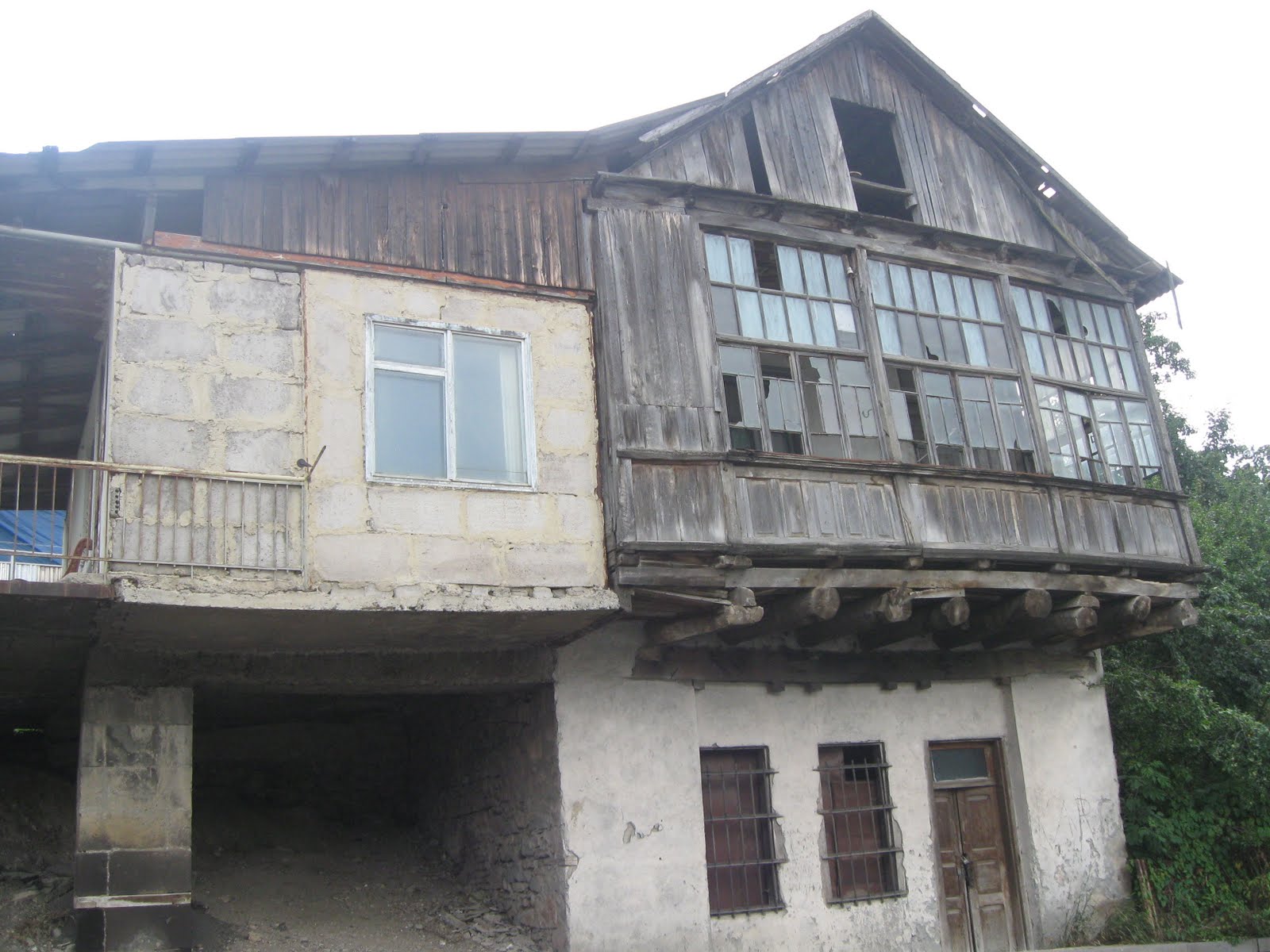
House which owners have attempted to make livable; note electrical wire to house

Crumbling stairs leading from one street to another, left from
damage of earthquake, 1988


      While walking around our town, which during Russian times was a thriving tourist destination, we see more empty buildings in the business area than occupied ones. People we’ve met say that after the earthquake of 1988 repairs were not done to damaged buildings. Then war erupted and again prevented reconstruction. Now sidewalks are broken up, streets are rift with potholes, and old buildings needing demolition still stand with broken windows, decaying wood frames and crumbling brick and block foundations. Moreover, the primary colors for attire in Armenia are black and white while the affect on the faces of those met on the street is flat or stern. We are told this lack of response to our “Barev dzez” (hello), is partially due to the fact that the Armenian culture believes if one does not know you, they do not greet you.  This is not the case in all situations but in many we’ve encountered as we walk around our town in an attempt to immerse into our new cultural home.


Example of many houses which are left standing but in need of major repairs
Sidewalk I use to walk to my school; very poor condition and unsafe
          Visitors to our town  are  disappointed in what they find yet there is amazing potential for tourism in such a naturally beautiful place. There is a lovely relatively new art museum at the edge of town and an informational history museum in the older section which features local crafts, art and gift items. A few excellent Armenian restaurants are available although we find that our favorite café closes from late October to April due to winter weather and declining business. Numerous bed and breakfasts are listed on tourism literature, but their quality and offerings are not known. There are no entertainment venues and no church in the town.                                                     
        One of Dave’s projects is to work with a local NGO (non- governmental organization) in the development of some aspect of tourism which could be marketed to international travelers.  With the realization that needed costly repairs of infrastructure will not be accomplished due to the lack of money, the focus may be on outdoor activities such as hiking, campinp, and backpacking in the surrounding mountains. In the past, trails were present and well utilized because maintenance was provided by the Soviets. Once Armenia established itself as an independent country, there was neither the money nor manpower to promote this type of activity. Hopefully, David and his counterpart will be able to assess what is present, gain the interest of volunteers to make improvements, draw up trail maps, and begin to advertise this facet of our town’s resources for tourists.
Beauty exists in our town with flowers flourishing everywhere.
There is hope that other aspects of the town will bloom as well. 

New construction in the center of town offers hope for the future.
                                                   

Young boys on the opening day of school in our town, September 1, 2011
 
              It is disconcerting to us to hear that the population of Armenia is decreasing with each census.  Many people now either move to Russia or go there for part of each year because of job availability. This causes disruption of family units but does provide necessary income for them to live. Armenians are hard- working, family- oriented, resilient people. Not only have they as a people endured a difficult past, they also live hard lives as individuals. Their future could be brighter with major economic changes. Currently taxes are high, wages are low, and people are financially desperate on many levels.  Government corruption exists and the unemployment rate is 40% and higher among the young (people under age 35). I feel bleak about the future of Armenia, maybe because I’m writing this piece on a chilly, dreary day in August when long johns are worn and clothes have yet to dry on the outdoor line.  Maybe when school starts next week and I become involved in the enthusiasm of students eager to learn my native language, will it seem more positive. The young people of Armenia are beautiful, smart, and full of positive energy. It is my hope that our town and all of Armenia will be able to flourish again, due in part to the contributions of these young people.      
     Dave and I will have 2 years to serve with Peace Corps Armenia.  We do challenge those who deem it to be a posh assignment. Even though we’ve experienced amazing cultural events during our training and we are not living in a mud hut without electricity or running water, the challenges of need and how to help these people help themselves are tremendous in Armenia.
The mountains  are majestic, beautiful , and inspirational.
They help to balance the negatives of  Armenia's decline and a tragic history.
      Please follow our story to see if, or how, our perspective changes.    Judy and Dave
                                                                                           

Thursday, September 1, 2011

WE WERE THERE

Service with the U.S .Peace Corps involves trying to meet the 3 goals established when the organization was founded in the early 60’s.  During 2011, the Peace Corps is celebrating its 50th anniversary. As new volunteers, we are acutely cognizant of the goals set forth by our predecessors. These goals are: 1.To help people of interested countries meet their needs for trained men and women.  2. To help promote better understanding of Americans on the part of people served.  3. To help promote a better understanding of other people on the part of Americans.  We think that our service will reflect those goals, and we’ll strive to meet them to the best of our ability.
                                                
      The breeze blew softly through the large, heavily paned windows which were now pushed open to allow air into the stiflingly warm room. The lace curtains fluttered. A young woman’s hair blew into her face as she moved closer to the window to enjoy a bit of the cool passing air. A well- articulated voice could be heard within the room as a group of twelve people quietly moved about the room, stopping briefly at certain points to listen more carefully to what the young woman was saying. Several more people stepped closer to the windows when possible, not wanting to move too far from the speaker’s voice, yet feeling the need for a measure of comfort offered by the soft breeze.

Republic Square in Yerevan, Armenia
location of National Gallery of Armenia

Dave and other Peace Corps volunteers in Republic Square to visit
National Gallery of Armenia and National History Museum 

Center of Republic Square in Yerevan, Armenia

    Amazingly, this scenario took place in Yerevan, Armenia, in the National Gallery of Armenia. As part of our cultural education, our training group was taken there by the Peace Corps. We were surprised by the lack of climate control in the spacious gallery which held art pieces dating back hundreds of years. How could these precious works of art be maintained indefinitely with exposure to varying temperature, damaging light and air pollutants? The gallery showcased the works of numerous Armenian, Russian and Western European artists.  The most complete part of the National Art Gallery is the collection of Armenian paintings.  The driving force behind the gallery’s image and character was Rouben Drambian, brought to Yerevan from Leningrad in 1925. Through his sensitive judgment and leadership, purchases have been made to augment the collection. Today, The National Gallery is the most attractive center for every Armenian artist, no matter where he/she resides.                                                           

Joseph Andriano accompanied by Michael Braz, piano, and Stephanie Conrad, cello,
singing "Chinar Es", a beloved Armenian song recorded by Komitas

        Works impressive to Dave and me included one artist’s self- portrait composed completely in a unique stone mosaic. Large sculptures of famous Armenians graced the center of many gallery rooms. The painting of Komitas, the musician credited with writing down all of the vocal music of Armenia, was prominently displayed. This quiet, gentle yet massive work of art was one of my favorites. It spoke strongly of music’s influence and value to the Armenian people who survived the genocide of 1915-17. During our recent Peace Corps swear-in ceremony in Yerevan’s Komitas Chamber Music Hall, one of our fellow Peace Corps volunteers, Joseph Andriano, sang a tenor vocal selection, “Chinar Es” recorded by Komitas. Joseph stated that performing this piece of music in Komitas Chamber Music Hall was the highlight of his musical life.   
      Throughout the gallery, art met nature through open windows. Although the gentle breezes reached inside to cool us on a hot day in Yerevan, Armenia, a surreal feeling surrounded us. How was it that we Americans were in this place at this time, in a treasured art gallery in a country many of us knew little about?   As part of the Peace Corps’ Goal #3, we were learning something about the culture of the small country and its resilient, talented people. Above and beyond wars, genocide, earthquakes and tough economic times, the National Gallery of Armenia spoke to us through its artists and through the work of its staff.
     In memory of all the artists and other talented, well- educated Armenians who were put to death during the historic genocide, we give thanks for the preservation and restoration of their works. We have faith that other visitors to this beautiful place will feel the same way.     Judy


Trees planted annually in the Genocide Memorial Garden
in memory of those who died during the genocide of 1915-1917
Yerevan, Armenia


Monday, August 22, 2011

A LOOK BACK AT HISTORY-----through the Eyes of an Armenian Woman

       Where were you in 1988? It seems light years away, doesn’t it?  Now I find myself sitting in the home of a woman Dave and I just met in Armenia. She is an English teacher in Dilijan where we’ll live for the next 2 years, and she invited us to dinner along with another Peace Corps volunteer who will be teaching English in her school.  We are joined by a local history teacher who speaks no English. By the end of the evening, we’ve heard of the horrors of the 1988 earthquake which killed thousands of Armenians and was soon followed by war with Azerbaijan, the Armenian’s neighbor after the fall of the Soviet Union.
        Our new friend was studying and working on her teaching credentials in 1988 and also working in a factory. She painted a brief picture of her experience during the years during and after the earthquake which occurred primarily in Spitak and Gyumri, Armenia, basically ruining these cities. Imagine feeling the ground shake without warning, the machine on which you are working vibrating and the lights flickering off. Your world collapses into a chaotic abyss and the next few months and years are filled with devastation, war and death.    
       Our hostess lived through those times with her parents. For part of the time, her family fled to Russia with many other Armenians. She told of her home being in total shambles and disarray and needing extensive repair. Even so, after 5 years of tragedy, horror, hunger and displacement, the family returned to Armenia to rebuild their lives. Our hostess remembers the aid offered by the US, European countries and others. She remembers the clothes sent by Russia with sleeves missing or only 1 pants leg present. She recalls the terrible times, yet smiles with positive thoughts.
Memorial to Armenians killed in WW II   Kotayk, Armenia
       This Armenian woman survived, her parents and siblings lived, and now 23 years later she relates portions of her story to us. The history teacher at our gathering provided pertinent historical details covering the war which soon followed and added to the earthquake’s destruction. The Armenians were expected to be easy targets due to the losses of life wrought by the natural disaster, however, the Armenians are resilient and strong. They had already survived war, the genocide of 1915-17 and other horrors. They were not ready to succumb and become over powered again. Now today this woman is a well- educated teacher who works hard to help her students learn English. She has lived through much to achieve what she has.
Genocide Memorial  Museum in Yerevan, Armenia
memorializing victims of first Genocide of the 20th century

Hard- working Armenian woman tending her family's garden

         As we sit in her apartment together, our new friend expresses what she thinks of her country and of life in general and says it is currently perfect, just perfect. After her life of living in a poverty-ridden, war torn country and suffering so much loss in her life, she now sees beauty and happiness. Shocked to hear the story from our parents about sending money to “starving children in Armenia” during WW I, she could only speculate as to what these offerings of help might have meant to the Armenian people attempting to save their country.       
        We felt numbed yet inspired by this woman who lived through the imagery we received from television during the 1988 earthquake. We felt empathy for her relatives who suffered yet survived the wars and the genocide. For this and countless other experiences, we are grateful to the US Peace Corps for the opportunity to meet people in other parts of the world who share their world with us--the good, the bad, the horror and the hope. Through this exchange, our world becomes smaller and our understanding of people worldwide grows. So let it be, that we impact people positively by sharing ourselves, our knowledge, and our culture. In turn, we will share what we learn about Armenia with our contacts in the U.S.  That is our aim. That is our mission as US Peace Corps volunteers in Armenia.  Judy and David                              
                                                                                       

Saturday, August 20, 2011

LITTLE THINGS MEAN A LOT------in ARMENIA

Peace Corps Model School classroom, Nor Hojn, Armenia
Photo by Peace Corps volunteer,  Tamara England-Zelenski
           Every day, small seemingly insignificant occurrences begin to take on a life of their own. They begin to add up, and compose a descriptive image of what life as a Peace Corps trainee is really like in Armenia. Life is made up of many small events.  “Little Things do Mean A Lot” as the old song goes.
            Last week marked the end of our Model School in which those of us who  are TEFL’s, or teachers of English as a foreign language, taught various ages of students different subjects using English as the focus.  We taught 6 different classes and during that time my teaching partner and I found that we can plan lessons and execute them in the classroom but need to work on classroom management.  We were “softies”, setting rules for behavior but not enforcing them, especially in one rowdy class of 9-11 year old students numbering 31. It is apparent that my first project upon reaching our new site will be to read more on techniques to deal with student behavior in the classroom setting. The reassuring part of this is that many of my peers will be facing the same challenge as TEFL’s who have not previously taught in a regular classroom.
            Just recently our household needed laundry detergent. I was actually recuperating from what is now called the “Peace Corps Bug” by our training group so David went to the village khnoot (store) and purchased a box of powdered laundry soap.  Upon return to our toon (house), he showed me his purchase. The large colorful letters on the detergent box read BARF.  The name definitely described how I felt. When our host Mother saw it she pointed to the fine print which said in English “for hand laundry”.  Since our family does have a real washing machine which they generously share with David and me, we do not do hand laundry.  BARF was successfully traded by our host Mother for Persil, another brand of laundry detergent.  Our washing machine was happy.

Judith Arvidson-Berg and David Smith, Peace Corps Volunteers

          One of our fellow trainees is a delightful 71 year old lady who has worked and lived all over the world. She is a trooper in the truest sense of the word. Judith lives with a young family whose 5 year old son actually had a bicycle with training wheels, a rarity here in our village. The child was still relying on the training wheels when Judith suggested taking them off. The family, though hesitant, followed her suggestion. The child was riding the bike independently within a week. Now that’s a sustainable Peace Corps project!                 
             We were trying to have a photo made of our village volunteers and language trainers on the last day of our language classes. We were all gathered in front of the school, looking for someone to take the photo when the principal arrived. I motioned to him and thought I asked him if he would take our photo.  It was obvious that my communication failed when the principal smiled broadly and stepped onto the steps in front of his school with all the volunteers, ready to have his photo made with the group!  I believe I still need lots of work on my Hayeren!
 Peace Corps volunteers with Principal at Kotayk School
                                                                                        
             Our host Mother and older son share a computer. She has been very interested in our blog, photos and other computer related subjects. Although she knows a bit of English, she certainly can not read a lengthy blog in English.  A younger volunteer told me about GOOGLE Translate so that we could have the blogs translated into Russian which hour host Mother reads well.  She was thrilled to read of her family as described in my first 2 blogs and wants to continue with the GOOGLE process on her own. What a great cultural exchange that has turned out to be.
Armenian rug- making loom with rug in progress
     Recently several of the women in our group visited a local family who makes beautiful woolen Armenian rugs. Their huge loom is set up in a small room in the home, apart from the living space where several rugs are displayed. We saw the mass of colors of yarn and a rug in progress on the loom. These young women already sell their creations in Paris and other international markets. One of the Peace Corps volunteers viewing the rugs has a friend in the US who sells handmade rugs and who may be interested in Armenian rugs. If that materializes and this small village rug maker is linked with a US outlet for her rugs, another cultural exchange has developed.
 Armenian wool in variety of colors for rug in progress
                                                                               
                                                                                                    
        Then, Ed, my TEFL teaching partner, was the recipient of a small piece of paper with the word “arrogant” imprinted on it. This paper was given to him by a 9-11 year old girl as she left our class the first day we taught. The next day the same child quickly slipped another piece of paper to Mr. Ed as she left the room. On it was the word “confident”. We will not be teaching these children again. Who was this child and where did she learn those words?---or did she even know what the words meant in her limited understanding of English? Mr. Ed will never know, but liked “confident” better.
          These happen-stance occurrences are only a few to be shared and these are during our Peace Corps pre-service training.  Wonder what will occur during our next 2 years to prove that indeed, little things do mean a lot?     Judy


Bari Gisher (Good Night) little Armen.............